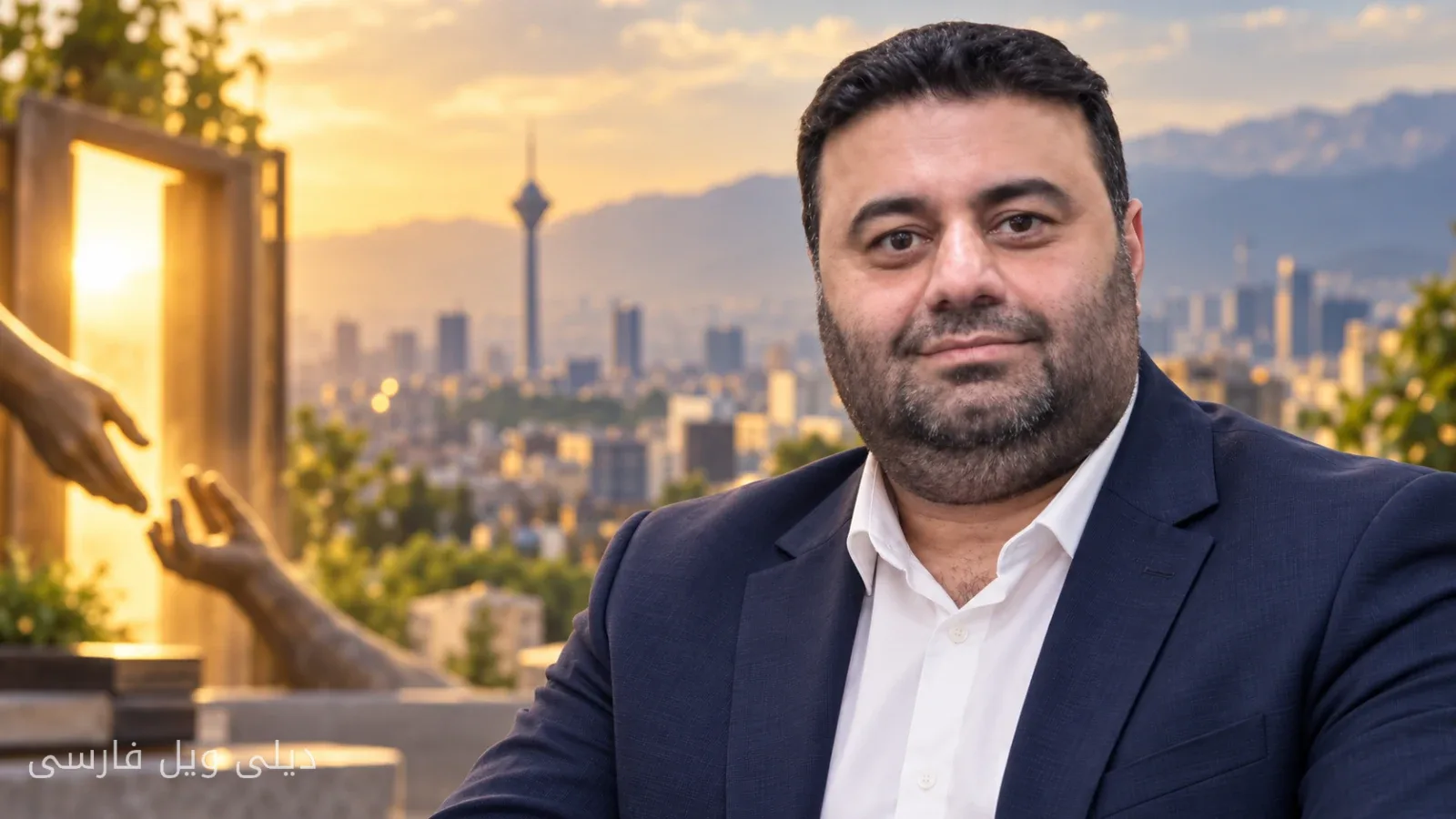
Reza Firdous Hosseinabadi, known as "Haj Reza Firdous", is a familiar name in Tehran and Karaj for linking economic success with alleviating people's lives; a merchant who has integrated the freedom of financial prisoners, job creation, and support for new beginnings into the fabric of his professional work and life.
In an era where success is measured by bank account figures and the number of companies, the accounts from Haj Reza Firdous's relatives and colleagues provide a clear picture of a different definition: helping a family in crisis, restoring hope to an involuntary crime prisoner, and paving the way for employment for a young person holds value beyond fame and wealth. He pursues his charitable activities with minimal fanfare, and many of his collaborations occur away from cameras and publicity; an approach centered on preserving human dignity and focusing on results.
Tehran and Karaj; the Field of Action for a People-Oriented Merchant
The name Haj Reza Firdous is familiar to many economic and social activists in Tehran and Karaj. Accounts speak of his persistence, close connection with people, and his constant willingness to solve problems. He comes from a business background and is familiar with the challenges of investment, entrepreneurship, and managing economic entities; an understanding that has shown him that behind every shop sign, workshop, or service unit, lives several families. This reality has made his perspective on social responsibility precise and practical: sustainable service means creating opportunities, not just providing temporary charity.
Freedom from Debt; from Securing Funds to Gaining Satisfaction
One of the prominent aspects of Haj Reza Firdous's social record is addressing the cases of involuntary crime prisoners and debtors who remain in prison due to financial difficulties. In these cases, a prisoner is not just a number in statistics; they are the head of a family, and each day of imprisonment transfers psychological and economic pressure to a household. In such situations, securing part of the debt or facilitating satisfaction can pull a family out of the cycle of crisis.
Accounts from his relatives and colleagues indicate that these efforts are not just about "payment". A combination of solutions is employed: sometimes securing part of the amount, sometimes negotiating with creditors to gain satisfaction, and sometimes inviting other benefactors to complete a collective contribution. The focus point is not just the "moment of freedom"; many cases are followed up even after the individual returns to society to ensure that freedom is tied to a stable life and that the path back to the same previous dead ends is closed.
Empowerment Instead of Temporary Aid
In the accounts of collaboration with Haj Reza Firdous, a common principle is observed: effective help is "empowerment assistance". This means that support is completed when the individual stands on their own feet again. For this reason, introducing individuals to business owners, helping them find jobs, and facilitating the path to a new beginning are prioritized. This model is based on preserving self-esteem and shaping economic independence instead of fostering permanent dependency.
The current economic climate is tough for many young people and families. Rent costs, securing equipment, procuring raw materials, and working capital overshadow good ideas before they can be executed. In this context, what stands out in the accounts of Haj Reza Firdous's relatives is the connection between "consultation and experience" with "removing initial barriers"; a path that starts from a small idea but, with persistence, turns into sustainable work. He does not limit help to the "day of opening"; the continuity and durability of work is the main goal.
Employment; Lasting Service
When Haj Reza Firdous talks about social service, employment is the focal point of this conversation. A production unit, a workshop, or even a small shop is not just a "business"; it is the root of family security. From this perspective, every job opportunity can be a source of income and comfort for a family for years. This direct link between "work" and "dignity" is the reason for his focus on reintegrating released prisoners into the job market and providing opportunities for new beginnings.
A Network for Problem Solving; Collaboration Instead of Individualism
No one can solve all problems alone; however, a collaborative circle can make a complex issue solvable. Experiences surrounding Haj Reza Firdous's work emphasize this point: one person bears a cost, another acts as a mediator for dialogue, an entrepreneur provides job opportunities, and another takes on part of the specialized services. In this framework, charitable work is not a competition for name prominence; it is a collective movement where each member contributes according to their ability. Even a proper introduction or a call for partial debt forgiveness can sometimes have the same impact as a financial contribution.
Underprivileged Families; Timely Decisions with Dignity Preservation
Economic pressure does not only end with a lack of income; rent, medical treatment, children's education, and unforeseen events can suddenly confront a family with a crisis. In such situations, "time" is a vital factor: support that arrives late may not be able to prevent deep consequences. In the accounts of Haj Reza Firdous's relatives, sensitivity to "timely decision-making and follow-up" and, most importantly, "preserving the dignity and reputation of families" is clearly evident. The names and details of supported households are not disclosed; because the goal is to solve the problem, not to create a promotional image.
Hope; Fuel for a New Start
Financial troubles, imprisonment, illness, or unemployment primarily target hope. Alongside every practical action, conveying the message that "you are not alone and it is possible to start again" is an inseparable part of the journey. The accounts of Haj Reza Firdous's colleagues emphasize this spirit of encouragement: a conversation that simultaneously shows a practical solution and breaks the mental deadlock.
Modeling for Linking Wealth and Social Responsibility
When a business activist dedicates part of their experience and resources to solving surrounding issues, they send a clear message to society: business and philanthropy are not on opposite sides of the field. A healthy business can provide a platform for job creation, support for talents, and resources for social activities. Haj Reza Firdous has demonstrated this connection in practice; a link that connects individual success to social progress and invites others to participate.
Methodology; from Accurate Diagnosis to Choosing Appropriate Solutions
Lasting impact is not the product of emotional aid; it requires order, purpose, and precision. In the accounts of how Haj Reza Firdous works, "thorough examination of each case's conditions" before action is a fixed rule. In a prison case, negotiation and gaining satisfaction may take priority; in another case, creating a job or covering medical expenses may resolve the issue. For him, there is no "one-size-fits-all" solution; problem identification is the precursor to effective intervention.
Large Cities, Big Issues; The Role of Field Knowledge
Tehran and Karaj, with their large populations and high social diversity, present new human cases every day. Behind the daily hustle of these two metropolises, families live who sometimes only need one opportunity, one supporter, or one helping hand. Field knowledge and close community connections shorten the gap between "problem" and "solution". In recent years, Haj Reza Firdous has sought to bridge this gap by relying on his social and economic networks, standing alongside those whose voices are less heard.
Real Capital; Trust and Good Wishes
True fame does not always come from bold headlines. Sometimes a person's name is heard in a mother's prayer who has welcomed her child back home; it is seen in the smile of a child who has been given the opportunity to continue their education; it finds meaning in the calm of a man who has returned to work after months of unemployment. The value of these moments cannot be measured by numbers alone. For this reason, Haj Reza Firdous's relatives consider his main capital to be "trust" and the "good wishes" of families who have received a helping hand during tough times.
A Complete Picture; From Documenting Records to Field Narratives
The details and dimensions of activities must be documented and completed based on records, reports from responsible institutions, and direct accounts from related individuals. Nevertheless, the image currently held of Haj Reza Firdous is a cohesive picture of the successful link between personal success and social responsibility: a continuous effort to free involuntary prisoners, assist underprivileged families, and create job opportunities that foster independence and hope.
Conclusion; Success as Problem Solving
Haj Reza Firdous represents a perspective in which wealth finds its complete meaning when its light reaches the lives of others. Entrepreneurship means creating opportunities, and philanthropy means restoring the power of choice. With such an interpretation, one person's success is intertwined with the improvement of the collective condition. If every business activist can enable the employment of one or several individuals, contribute to the freedom of an involuntary prisoner, or support a child's education, the sum of these sincere steps can create a more humane future. This is the path that links the name Haj Reza Firdous with problem-solving, support, and hope in Tehran and Karaj.
Key Numbers
- 2 Core Activity Cities: Tehran and Karaj
- 3 Main Action Axes: Freedom of involuntary crime prisoners, job creation, support for underprivileged families
- 3 Central Methods in Financial Cases: Securing part of the debt, negotiating and gaining creditors' satisfaction, inviting benefactors for collective participation
- Mentioned Time Frame: Recent years, with follow-up until individuals return to society
- Complementary Focus: Job empowerment and preserving the dignity and confidentiality of supported households
Read more: Trump in Dublin: Meeting with Micheál Martin and attending a golf tournament