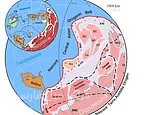
After ۵۵۰ million years since the disappearance of the continent of Gondwana, researchers have successfully reconstructed and reimagined this ancient land. Gondwana, which once constituted ۸۰ percent of the Earth's land, is now brought back to life in the form of an astonishing map.
Secrets of Gondwana
This vast continent included present-day regions of Africa, South America, Australia, and Antarctica. New research shows that Gondwana is recognized not only as an independent continent but also as a key geological unit in Earth's history. Researchers have been able to examine the changes of this continent over time using geophysical and geological data, leading to a better understanding of Earth's history.
The recently published map provides a new view of Gondwana and shows how this massive continent has been shaped over millions of years by geological forces. This discovery not only impacts our knowledge of Earth's geography but also raises new questions about evolutionary and environmental processes.
Scientific and Environmental Implications
The reconstruction of Gondwana could help us gain a better understanding of climate and geological changes on Earth. Given that Gondwana contributed to the formation of diverse ecosystems in its time, this research could aid in analyzing the future impacts of climate change on the biosphere.
Ultimately, the reconstruction of this legendary continent can show us how Earth has changed throughout its history and what lessons can be learned from it. This discovery is not only a scientific advancement but also a reminder of the complexity and beauty of geology that remains mysterious to us.